Buying Real Estate in the Dominican Republic: Process and Taxes
17 August 2026
The Dominican Republic is one of the most open Caribbean nations for buyers from Slovakia and the Czech Republic: since 1998, foreigners have the same ownership rights as locals, you purchase full ownership including land, and in tourist zones like Punta Cana or Cabarete, well-managed short-term rentals typically show gross yields of approximately 6–10% per year. The state also offers the CONFOTUR regime, which can save a buyer tax on purchase and annual property tax. Here is the entire process, costs, and risks in one place.
Can a Foreigner Buy in the Dominican Republic?
Yes, without restrictions. Since 1998 (Decree 21-98, which repealed older restrictions from 1945), foreigners have the same ownership rights as Dominicans — a valid passport is sufficient. Full ownership (freehold) of apartments, villas, and land is purchased, including building land; there are no limits on the number of properties or special rules for EU citizens. Ownership is registered in the state register of titles (Registro de Títulos, Torrens system) and the owner receives a Certificado de Título.
The only exception: the coastal strip approximately 60 m from the high tide line is public domain. Land directly on the beach is therefore not owned — structures there stand on concessions. With "beachfront" offers, always verify what is actual ownership and what is only a concession.
Purchase Process Step by Step
- Offer and reservation, then a future purchase agreement (Promesa de Venta) with a deposit typically 10%.
- Legal review (due diligence) by your own lawyer: title certificate, confirmation of liens from the register, tax arrears (IPI), deslinde status (geodetic parcel delineation), for condominiums bylaws and fees, for CONFOTUR projects validity of decision.
- Final purchase contract (Contrato de Venta) signed before a notary and payment of the price — typically via escrow, for off-plan via fideicomiso.
- Payment of transfer tax 3% to the tax authority (DGII) and submission to Registro de Títulos; a new Certificado de Título in the buyer's name is issued in approximately a few weeks to months.
The entire process for a ready property with clear title takes approximately 1–3 months; for off-plan it is governed by the construction schedule. Long-distance purchase is common — power of attorney with apostille, signatures handled by the lawyer and the client need not fly in. The lawyer also obtains a local tax number (RNC) for the client, needed for registration and taxes.
Fees and Taxes at Purchase
> The Globeya Full Service is added to the developer's or seller's price. It covers the whole service, legal work included — a lawyer, legal checks and contract translation. It is paid once, on signing the contract, together with the down payment. Taxes and official state fees are not part of it — you will find the main ones below; we tell you the exact amounts for your specific project in advance and go through all the terms with you in a consultation.
- Transfer tax: 3% of price or DGII valuation. For projects approved under CONFOTUR, the buyer is exempt.
Sales of new residential apartments are not subject to VAT (ITBIS).
What is CONFOTUR and How Much Does It Save
CONFOTUR is a state support regime for tourist projects. For the buyer it means two specific savings: exemption from 3% transfer tax at purchase and exemption from annual property tax (IPI) for up to 15 years — the period runs from the project (per interpretation from its approval, or completion of construction), not from your purchase, verify the exact end date in the CONFOTUR decision. For an apartment at 200,000 USD this is a combined saving in the tens of thousands of USD. However, two things must be guarded: the CONFOTUR decision must be genuinely issued (not "in process") and you must know how long it applies — benefits do not automatically transfer at the next sale.
Annual Owner Costs
- Property tax (IPI): 1% per year, but only on the sum exceeding approximately 10.7 million DOP (approximately 175,000–185,000 USD, threshold adjusted annually); value below threshold is untaxed. In a CONFOTUR project, the owner is exempt from IPI for up to 15 years.
- HOA fees: in condominiums approximately 80–300 USD per month depending on resort and services — pools, beach service, security; in large Punta Cana resorts can be higher.
- Utilities: electricity is relatively expensive and air conditioning increases bills — with active use of an apartment budget approximately 100–300 USD per month.
Rental and Yield
A foreigner may rent without restrictions. Short-term rental (Airbnb) is nationwide legal, without license and without limit on number of nights — regulation is however pending — MITUR in 2026 prepared mandatory registration of units in the RENATUR register (implementation from July 2026 is currently suspended), so budget for a registration requirement in future. Real restrictions come from condominium bylaws: some Punta Cana and Cap Cana resorts limit short-term rentals, so read the bylaws before purchase.
Taxes: a non-resident's rental income is taxed at source at approximately 27% of gross rent (final tax, no deductions). Short-term accommodation formally also subject to 18% ITBIS (VAT) — practice of collection via platforms is evolving, set up with a local accountant. Some CONFOTUR projects also mention exemption of rental income; this depends on the specific CONFOTUR decision and must be verified by a lawyer.
In tourist zones (Punta Cana/Bavaro, Cabarete) with well-managed short-term rental, gross yields are typically approximately 6–10% per year — strongly depend on occupancy and quality of management. Property management firms charge approximately 15–25% of revenues.
Residence and Visas
Purchasing real estate does not grant residence. Slovaks and Czechs travel visa-free: tourist entry is valid for 30 days and can be extended online or by fee at departure up to approximately 120 days.
For more, there are three options. Investor residence: expedited permanent residence with investment from 200,000 USD (deposits, company; real estate purchase itself may not count automatically — handled via company or CONFOTUR project and structure set up by lawyer). After approximately 6 months of residence, citizenship can be applied for; mandatory minimum stay does not exist and residence renews every 4 years. Pensionado: for pension recipients from 1,500 USD per month. Rentista: for passive income from 2,000 USD per month.
Financing
Local banks (Banco Popular, BHD, Scotiabank) offer mortgages to foreigners, but with own deposit 30–50% and interest rates approximately 8–14% (loans in DOP and USD) — for clients from the EU this is rarely attractive.
For off-plan, developer financing is standard: during construction the price is paid in instalments 30–50% (typically interest-free) and the balance on handover. Reputable projects run through fideicomiso (Law 189-11) — buyers' money is held by a licensed trustee-manager, protecting deposits against developer failure. Clients from SK and CZ typically finance the purchase with a loan secured by domestic real estate; domestic banks will not take Dominican real estate as collateral.
Risks and What to Watch Out For
- Title. Buy only with proper Certificado de Título and completed deslinde. Land with only constancia anotada (undelineated share) is risky — this affects mainly older land on the north coast around Cabarete and Sosúa.
- CONFOTUR. Verify that the decision is genuinely issued and how long it applies; benefits do not automatically transfer at the next sale.
- Off-plan. Check the developer (completed projects, fideicomiso or escrow) and contractual penalties for delay; never pay to a private account without a contract.
- Coastal 60 m strip. With "beachfront" land, find out what is ownership and what is only a concession.
- HOA. Read the bylaws — rental limits, fee increases, reserves fund.
- Contract price. Always use your own independent lawyer; don't artificially understate the contract price, it complicates future capital gains tax.
Sale in the Future
Capital gains tax is 27% of the difference between sale price and inflation-adjusted purchase price and applies also to non-residents. No time test exists — exemption after X years of ownership does not apply. At sale, the new buyer pays 3% transfer tax (unless they themselves have CONFOTUR benefit); the seller handles capital gains tax via DGII. Repatriation of sale proceeds is free, the bank will require source documents — purchase contract and paid taxes.
Frequently Asked Questions
Can I as a Slovak or Czech own real estate in my name? Yes, fully and without restrictions — your name is entered in the title deed (Certificado de Título), a passport is sufficient.
What does CONFOTUR really give me? You save 3% transfer tax at purchase and don't pay annual IPI tax for up to 15 years; for an apartment at 200,000 USD this is a combined saving in the tens of thousands of USD.
Must I fly in to sign? No, purchase via power of attorney with apostille is common; the lawyer signs and registers for you.
May I rent via Airbnb? Yes, license is not required; only limits may come from your resort bylaws. A non-resident's income is taxed at source at approximately 27%.
Is off-plan in Punta Cana safe? With projects using fideicomiso (money held by licensed trustee) and verified developers yes; key is due diligence before signing.
Will I pay tax if I sell in a few years? Yes, approximately 25–27% of profit (sale price minus adjusted purchase price); exemption by time does not apply.
Next Step
If the Caribbean appeals to you, we are happy to go through your budget, suitable locations, and whether a CONFOTUR project makes sense for you in a free consultation. Consultation does not commit you to anything. In the meantime you can view current offers in the Dominican Republic.
Information status: August 2026. Indicative information, not legal or tax advice.
Properties in this country
Listings — Dominican Republic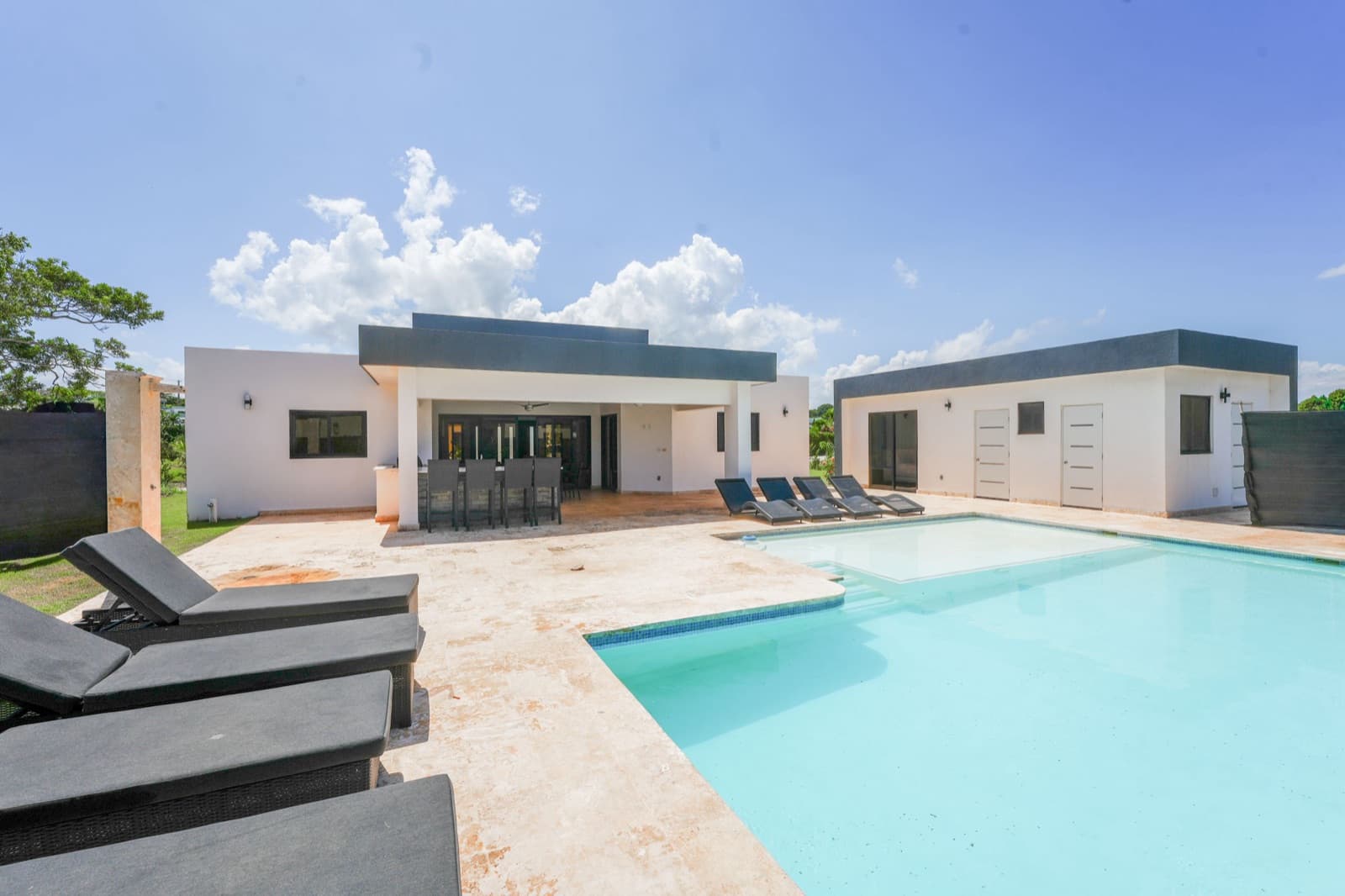 Dominican Republic · CabareteUnder construction
Villa Bella
Spacious tropical villa with 3 bedrooms and 3.5 bathrooms, area 192.3 m².
 Dominican Republic · CabareteUnder construction
Villa Capri
Villa Capri – tropical villa with 2 bedrooms and 2.5 bathrooms. Area 110.57 m². Price includes villa, lot, pool and landscaping.
 Dominican Republic · CabareteUnder construction
Villa Cascada
Villa Cascada – tropical villa with 2 bedrooms and 2.5 bathrooms. Area from 133.53 m². Price includes villa, lot, pool and landscaping.